Who is Toollense?
Toollense – or Ralf Tschorn – Inspection Solutions – was launched in 2023. The focus is on the sales and service of optical measuring and inspection systems for high-precision, mostly rotationally symmetrical cutting tools. Toollense operates in the same market environment as other manufacturers of tool measuring equipment – for example Zoller with pomBasic and Genius, Walter Helicheck, PG1000 or Marcel Aubert – and offers an independent optical alternative for the quality control of cutting tools.
Toollense is manufactured in China – but not by just any producer, rather by a highly specialized company that has been firmly established in the cutting tool manufacturing market since 2008. The development company employs around 20 experienced engineers and has been working exclusively on inspection systems for the tool industry for more than 17 years.
On this basis, the Toollense product line was developed in 2020 and successfully introduced. Today, numerous well-known tool manufacturers in China rely on this system – including Rollomatic, Vollmer, Walter, Sandvik and many others. Toollense therefore combines practical experience from the tool grinding market, technical specialization and continuous development specifically tailored to the requirements of tool manufacturers and grinding shops.
Is Toollense really “Made in China” – and what does that mean for quality?
Yes, Toollense is manufactured in China. What is decisive, however, is who manufactures it: the development company behind Toollense was founded in 2008 and has been fully specialized in inspection systems for cutting tool production for more than 17 years. A team of around 20 engineers develops measuring and inspection devices that are precisely tailored to the requirements of the tool grinding market.
In China, the system is already firmly established. Many well-known tool manufacturers already rely on Toollense – including Rollomatic, Vollmer, Walter, Sandvik and numerous other companies.
For European users this means: mature technology developed from the real needs of tool grinders, stable and practice-proven software, high image quality thanks to modern camera and lighting technology, and an attractive price-performance ratio made possible by an efficient production structure.
Toollense thus combines Chinese manufacturing expertise with European sales, service and quality standards – and offers an attractive alternative to established measuring systems from other manufacturers.
What is Toollense?
Toollense is a high-resolution optical measuring system for the precise inspection of cutting tools such as end mills, drills, reamers, taps, saw blades and many more. Thanks to its high-resolution camera and intuitive software, Toollense delivers razor-sharp images and measurements in the tenth-of-a-micron range (0.0001 mm).
Which tools can be measured with Toollense?
Toollense is suitable for almost all rotationally symmetrical cutting tools such as end mills, drills, threading tools, countersinks and special tools. Inserts or non-rotationally symmetrical tools can also be measured precisely depending on the application. Pure visual inspection of cutting edges, surfaces and tools is likewise possible.
How precise is Toollense?
The software determines precise measurements of lines, radii, angles, distances and edges with an accuracy of up to 0.0001 mm. Automatic edge detection ensures reproducible results with a repeatability at the highest optical resolution of less than 0.001 mm and, at the smallest resolution, down to 0.003 mm.
What advantages does Toollense offer compared to other measuring systems?
Toollense offers very high UHD image resolution, intuitive operation that leads quickly to measurement results, and an attractive price-performance ratio. For many users, the system is therefore an interesting option alongside established measuring systems such as Zoller pomBasic, Zoller Genius, Walter Helicheck, PG1000 or Marcel Aubert.
Is Toollense an alternative to Zoller, PG1000, Marcel Aubert or Walter Helicheck?
Yes. Many users employ Toollense as a modern optical solution for the inspection and measurement of cutting tools – also alongside other established systems on the market such as Zoller pomBasic, Zoller Genius, PG1000, Walter Helicheck or Marcel Aubert. All of these products essentially pursue the same objective: to visualize and assess tools, dimensions and geometries for quality assurance.
Toollense focuses on particularly high-resolution imaging of cutting tools and on simple, efficient operation. The integrated 4K – and, depending on the model, even 5K – technology makes cutting edges and tool geometries visible in razor-sharp detail. On the basis of these images, the software enables manual and, in some cases, semi-automated measurements in the micron range.
Through the combination of high-resolution optics and intuitive software, Toollense offers many companies a fast and practice-oriented way to perform measuring and inspection tasks directly at the grinding machine or in quality assurance. In this way, Toollense can usefully complement existing inspection processes or make them more efficient.
Is Toollense an alternative to Zoller pomBasic?
Many users see Toollense as an optical solution for the inspection and measurement of cutting tools – also in the context of other established systems on the market such as Zoller pomBasic. Such products share the same general purpose: visualizing and assessing tools, dimensions and geometries for quality assurance.
Toollense places particular emphasis on high-resolution imaging of cutting tools and on simple, efficient operation. The integrated 4K – and, depending on the model, even 5K – technology makes cutting edges and tool geometries razor-sharp on screen. Based on these images, the software enables manual and partially automated measurements in the micron range.
Through this combination of high-resolution optics and intuitive software, Toollense offers many companies a fast and practice-oriented way to carry out measuring and inspection tasks directly at the grinding machine or in quality assurance. Toollense can thus usefully complement existing inspection processes or help make them more efficient.
Is Toollense an alternative to Zoller Genius?
Zoller Genius is a fully automatic universal measuring machine for comprehensive measurement of all kinds of cutting tools. Toollense follows a different approach: it is a compact, manually operated optical inspection system focused on high-resolution imaging and particularly simple operation.
In practice, Toollense is often used by users when a flexible, image-based solution for daily quality control and documentation of end mills, drills and special tools is required – especially directly at the grinding machine or in the production area, as a complement to existing measuring processes.
Is Toollense an alternative to Walter Helicheck?
Walter Helicheck is a fully automatic measuring machine for complete automatic measurement of complex tool geometries. Toollense follows a different approach: it is a compact, manually operated optical inspection system with a focus on high-resolution imaging and very simple operation.
In practice, Toollense is often used by users when a flexible, image-based solution for daily quality control and documentation of end mills, drills and special tools is required – especially directly at the grinding machine or in the production area, as a complement to existing measuring processes.
How does Toollense differ from PG1000 or Marcel Aubert?
Systems such as PG1000 or solutions from Marcel Aubert are well-established measuring and inspection devices for cutting tools. In this environment, Toollense positions itself as a compact optical measuring system with particularly high image resolution and very intuitive software. Typical applications are fast visual inspection and manual measurement of radii, angles, distances and cutting edges on rotationally symmetrical tools. Many tool grinders use Toollense as an alternative or addition to existing measuring systems when fast, practical quality control is required.
For which users is Toollense interesting compared to Zoller & others?
Toollense is aimed at tool manufacturers and grinding shops that produce or regrind end mills, drills, reamers, special tools and similar cutting tools. Toollense is particularly interesting for companies that:
- need fast, simple and precise quality control directly next to the grinding machine,
- want to inspect tool geometries and cutting edges with high magnification and razor-sharp imaging,
- prefer intuitive, easy-to-learn software,
- want to use an optical inspection solution as a complement or alternative to existing measuring devices from other manufacturers (e.g. Zoller pomBasic, Zoller Genius, Walter Helicheck, PG1000, Marcel Aubert).
Do users employ Toollense instead of other measuring systems?
Yes, many users employ Toollense as an addition to or alternative to existing measuring devices from other manufacturers. Toollense is often used where fast, image-based quality control of ground tools is required – for example directly next to the grinding machine, for in-process inspection or final inspection. Thanks to the combination of high image sharpness, intuitive software and compact design, Toollense can be used almost anywhere and can usefully complement or simplify existing measuring processes.
Can Toollense be used directly next to the machine?
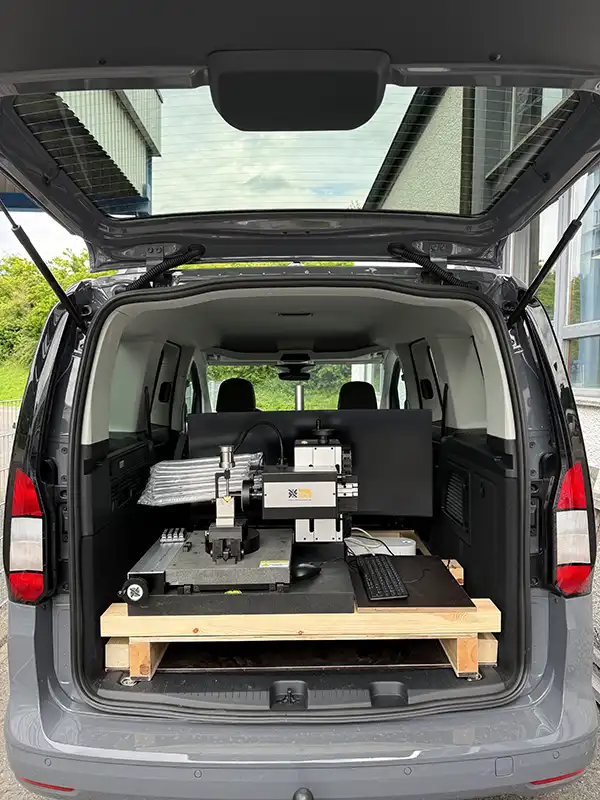
Yes. Toollense is compact, ergonomic and ideal for use directly next to your tool grinding machines. This saves walking distances, speeds up setup and production as well as quality control, and reduces scrap.
How easy is the Toollense software to use?
The software is deliberately designed to be simple and intuitive. It guides you to the desired measuring result with just a few clicks. Extensive training is not necessary – in most cases, Toollense users need only 1–2 hours of software training. The system is ready for use in no time.
Can you measure with all Toollense types?
Type E & Type C: full measuring capability
Type C plus: higher resolution, new software, additional measuring axis
Type V: purely visual inspection without measuring function
What magnification does Toollense offer?
Standard magnification goes up to 300x. Optionally, this can be extended to
500x or 750x.
Who is Toollense suitable for?
Toollense is aimed at tool manufacturers, tool grinding shops, regrinding services, quality control departments as well as training and technology centers. Manufacturers of medical or dental products and tools also use Toollense to check their quality.
Does Toollense offer good value for money?
Yes. Toollense offers a very attractive price-performance ratio. Users report that the combination of high image resolution, intuitive software and moderate investment costs enables a fast return on investment.
Is training available for Toollense?
Training is usually provided as an introduction during commissioning. Since Toollense is extremely easy to operate, this training is not extensive. On request, we offer onboarding and any additional support your staff may need.
Can I test Toollense live?
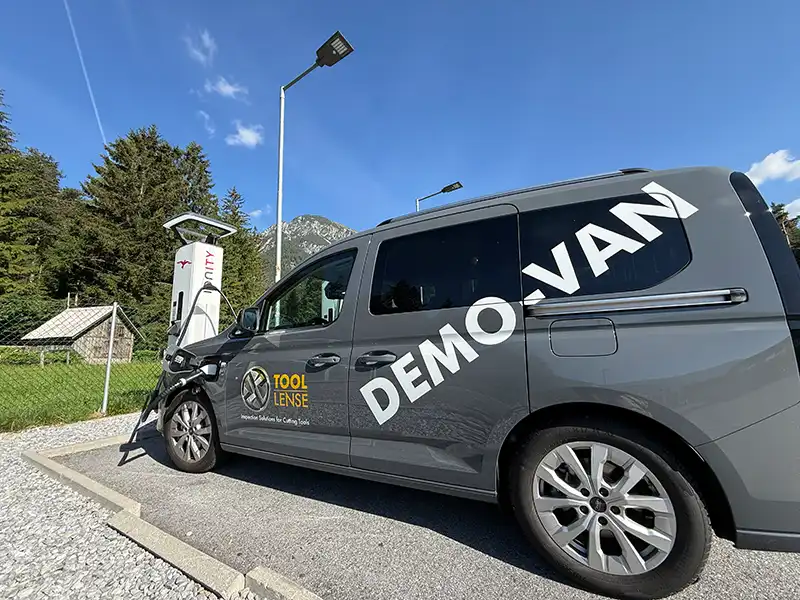
Yes, Toollense offers live demos, online presentations and on-site tests. You are welcome to bring your own tools or send your sample tools directly for tests and comparison measurements.